 Avec Sydney Hutchihnson*<
/p>
Avec Sydney Hutchihnson*<
/p>Avec Sydney Hutchihnson*<
/p>
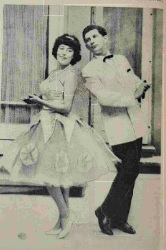
From the 1950s through the 1970s, East German choreographers, dance t eachers, composers, and ballroom enthusiasts worked to provide their social ist comrades with new dances that would express and encourage joy in the “n ew life” socialism provided. Drawing ideas from US, Latin American, and Eas tern Bloc trends and employing their own creativity, committees regularly p ut out dance ideas, premiered them in festivals, and encouraged “dance circ les” at businesses, villages, and neighborhoods to take them up. Mgazines p ublished dozens of these new choreographies and scores to allow for amateur recreation, and they spanned “Modetänze” (dance trends or social partner d ances), new folk dances, and imported international dances reworked in East German style. Only a few became popular; others were performed only on a s ingle occasion.
Understanding how these dances were created and used, as well as what they meant in their historical context, is one part of my larger project entitled “Second World Music: Latin America, East Germany, a nd the Sonic Circuitry of Socialism.” I will speak about how the social dan ces fit into my larger investigation into the performance of socialist inte rnationalism. I will also discuss the methodology I am employing to reconst ruct and perform the dances and their music as a form of participant-observ ation in a no-longer-existing dance culture. Together we will explore these new creations, their choreomusical successes and failures, by doing the da nces ourselves and considering our own bodily experiences of the material.< /p>
Sydney Hutchinson is a research associate at Humbold t University's Institute for Musicology and Media Studies in Berlin, German y. Formerly, she was associate professor of ethnomusicology at Syracuse Uni versity, visiting professor at Goethe University Frankfurt, and a Humboldt fellow at the Ethnological Museum Berlin. Hutchinson has published four boo ks on Latin American music and dance and a translation of Dominican singer- songwriter Rita Indiana's latest novel. Her most recent publications includ e articles on choreomusicology, gender and the body in Mexican norteño< /em> music videos, and merengue dancing. Earlier works have won awards from the Society for Ethnomusicology, Society of Dance History Scholars, and Am erican Folklore Society as well as the Samuel Claro Valdés prize for Latin American musicology.
X-ALT-DESC;FMTTYPE=text/html:
 Avec Sydne
y Hutchihnson*
Avec Sydne
y Hutchihnson*
From the 1950s through the 1970s, East German choreographers, dance teachers, composers, and ballroom enthusiasts worked to provide their socialist comrades with new dances that would express and encourage joy in the “new life” socialism provided. Drawing ideas from US, Latin American, and Eastern Bloc trends and employing their own creativity , committees regularly put out dance ideas, premiered them in festivals, an d encouraged “dance circles” at businesses, villages, and neighborhoods to take them up. Mgazines published dozens of these new choreographies and sco res to allow for amateur recreation, and they spanned “Modetänze” (dance tr ends or social partner dances), new folk dances, and imported international dances reworked in East German style. Only a few became popular; others we re performed only on a single occasion.
Understanding how these dance s were created and used, as well as what they meant in their historical con text, is one part of my larger project entitled “Second World Music: Latin America, East Germany, and the Sonic Circuitry of Socialism.” I will speak about how the social dances fit into my larger investigation into the perfo rmance of socialist internationalism. I will also discuss the methodology I am employing to reconstruct and perform the dances and their music as a fo rm of participant-observation in a no-longer-existing dance culture. Togeth er we will explore these new creations, their choreomusical successes and f ailures, by doing the dances ourselves and considering our own bodily exper iences of the material.
Sydney Hutchinson is a resea rch associate at Humboldt University's Institute for Musicology and Media S tudies in Berlin, Germany. Formerly, she was associate professor of ethnomu sicology at Syracuse University, visiting professor at Goethe University Fr ankfurt, and a Humboldt fellow at the Ethnological Museum Berlin. Hutchinso n has published four books on Latin American music and dance and a translat ion of Dominican singer-songwriter Rita Indiana's latest novel. Her most re cent publications include articles on choreomusicology, gender and the body in Mexican norteño music videos, and merengue dancing. Earlier wo rks have won awards from the Society for Ethnomusicology, Society of Dance History Scholars, and American Folklore Society as well as the Samuel Claro Valdés prize for Latin American musicology.
DTSTAMP:20261027T115931 DTSTART;TZID=Europe/Paris:20240129T100000 DTEND;TZID=Europe/Paris:20240129T120000 SEQUENCE:0 TRANSP:OPAQUE END:VEVENT END:VCALENDAR