Colloque "Distance and Speed in Inner Asia"
Colloques


Présentation
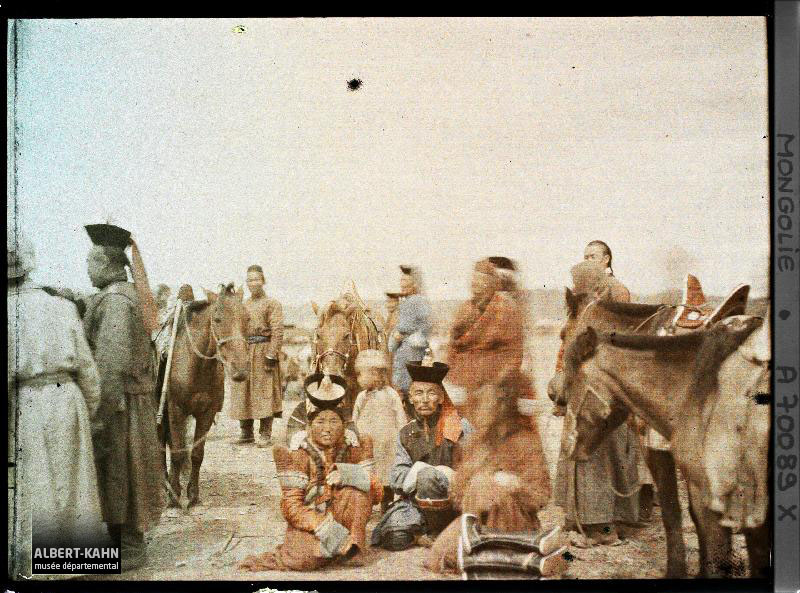
Il se tiendra sur deux jours, les 7 et 8 mars 2019, au Musée du Quai Branly, dans la salle de Cinéma. L'entrée est libre.
Ceux dont le mode de vie repose sur la mobilité, comme les pasteurs nomades, les chasseurs ou les commerçants itinérants, entretiennent des manières propres d’estimer les distances ; leur activité leur impose souvent aussi d’ajuster leur vitesse sur celle d’autres êtres. Les éleveurs dépendent ainsi pour leur subsistance de la relation qu’ils parviennent à établir et maintenir avec diverses espèces de bétail, chacune se caractérisant par un certain rythme et une allure particulière. Ces allures asynchrones doivent être coordonnées et temporisées (dirigées, relâchées, ralenties,
accélérées) au moyen de dispositifs permettant d’ajuster les relations respectives que différents types d’humains et de non-humains peuvent entretenir à l’espace qu’ils habitent conjointement.
La question se pose d’une manière toute particulière dans le contexte de l’Asie intérieure, où les modes de territorialisation – humains et non-humains – font la part belle au mouvement. Cette conférence sera ainsi l’occasion, à l’heure de la désertification, de l’exode rural massif et des mouvements migratoires transnationaux qui affectent la région, de s’interroger sur la notion classique et récriée de nomadisme. Le nomadisme tient-il seulement à la mobilité des animaux et des humains (mobilité plus ou moins importante, qui peut être associée à des écologies par ailleurs très diverses) ou peut-il être défini de façon plus profonde comme une certaine façon d’habiter les lieux – c’est-à-dire de s’en tenir à bonne distance en coordonnant les allures auxquelles sont parcourus les espaces?
DISTANCE AND SPEED. RETHINKING THE IMAGINATIVE POTENTIAL OF SPACE AND VELOCITY IN INNER ASIA
PROGRAMME (téléchargement en pdf)
THURSDAY, MARCH 7 (SALLE DE CINÉMA)
9h30 Caroline HUMPHREY (University of Cambridge) & Gregory DELAPLACE (Université Paris Nanterre) Introduction
Panel 1 – Pacing human and non-human gaits
Discussant: David SNEATH (University of Cambridge)
10h00 Charlotte MARCHINA (INALCO)
Coordinating speeds and keeping distance: herders and their animals in Mongolia
10h30 Alex OEHLER (University of Northern British Columbia) Pacing the multi-species household: examples from the Eastern Saian Mountains
11h00 Coffee break
11h15 Thomas WHITE (University of Cambridge) Governing animals at a distance: environmentality, responsibility, and pastoralist futures in Inner Mongolia.
11h45 Discussion
12h30 Lunch break
Panel 2 – The state at a distance
Discussant: Isabelle CHARLEUX (Centre National de la Recherche
Scientifique)
13h30 Lars HØJER (University of Copenhagen) The distant yet intimate temporalities of a Mongolian mining project in the making
14h00 Ivan PESHKOV (Adam Mickiewicz University, Poznan) From caravan routes to railroad lines: “speed” as spectacle of external modernity
14h30 Coffee break
15h00 Tatiana SAFONOVA & Istvan SANTHÁ (Central European University & Hungarian Academy of Sciences, Budapest) Astronauts of East Siberia: Broken Infrastructures and State Imitation in Isolated Village
15h30 Discussion
16h15 Movie screening. The Brigade, by Liivo Niglas (2000), followed by a discussion chaired by Dominique SAMSON(INALCO)
18h00 Cocktail
FRIDAY, MARCH 8 (SALLE DE CINÉMA)
Panel 3 – In and out of the nutag
Discussant: Morten PEDERSEN (University of Copenhagen)
9h30 Bumochir DULAM (Mongolian National University, Ulaanbaatar) Understanding nationalism through nutag in contemporary Mongolia
10h00 Bernard CHARLIER (Catholic University of Leuven) From the countryside to the city, missing the homeland among new migrants in Ulaanbaatar
10h30 Gregory DELAPLACE (Université Paris Nanterre) The ruler, the wrestler and the archer. Imposing oneself and composing with the (home)land in Mongolia
11h00 Coffee break
11h15 Sayana NAMSARAEVA (University of Cambridge) Understanding nutag re-entry motion
11h45 Discussion
12h30 Lunch break
Panel 4 – Mapping out speed
Discussant: Caroline HUMPHREY (University of Cambridge)
14h00 Laurent LEGRAIN (Université Toulouse Jean Jaurès) Frictions of terrain and attention to the world. How to deal with the scattering effect in Mongolian rural daily life
14h30 Christos LYNTERIS (University of St. Andrews) Distancing Plague: Alexandre Yersin and Disease Mapping in 1898 Nha Trang
15h00 Discussion
15h30 Coffee break
Panel 5 – Making journeys
Discussant: Rebecca EMPSON(University College of London)
15h45 Caroline HUMPHREY (University of Cambridge) Horse-relay (örtöö) and caravan (zhin): the imaginative implications of two modes of transport in early socialist Mongolia
16h15 Charles STÉPANOFF (EPHE)
Finding the way among the skies: Shamanic maps and mental paths
16h45 Discussion and Concluding remarks